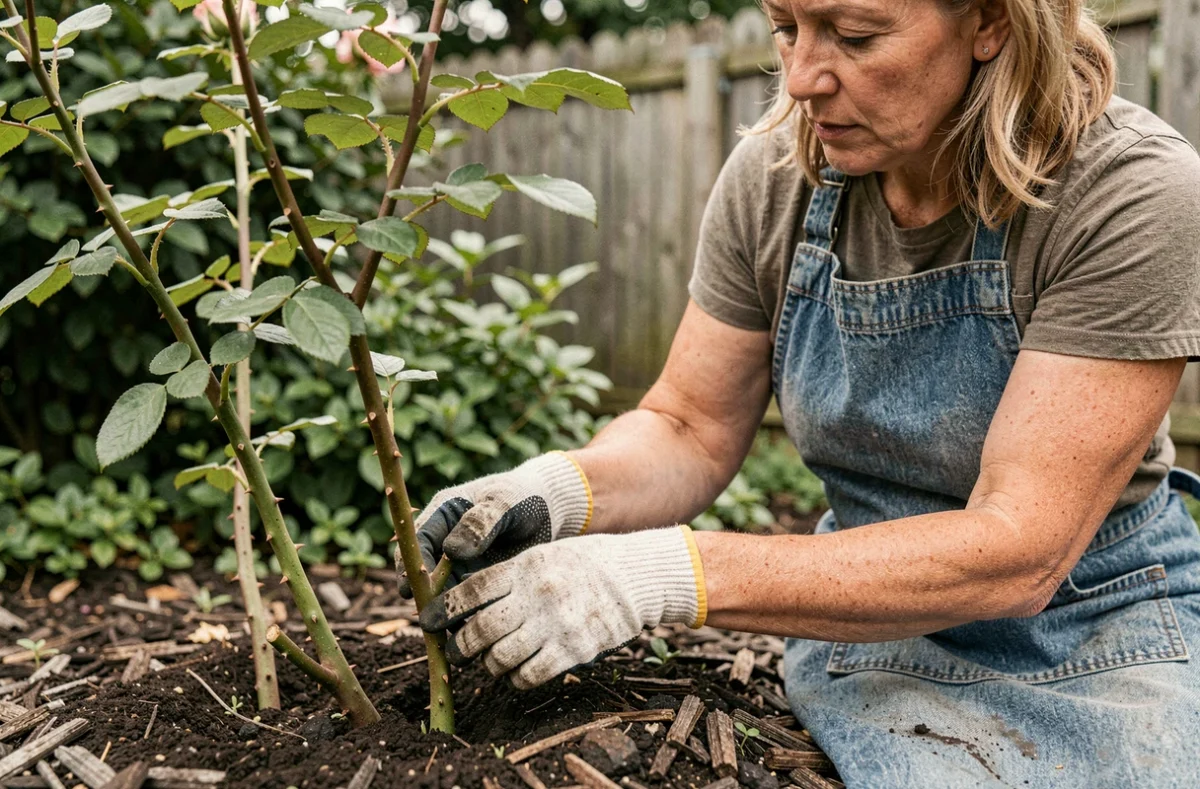
A vigorous shoot from a rose bush is not simply a vigorous sprout. It is a sucker emitted by the rootstock, below the grafting point, which draws sap at the expense of the grafted cultivar. Confusing a sucker with a basal branch of the cultivar leads to the removal of productive wood. We recommend making the correct diagnosis before any intervention.
Diagnosis of the sucker: leaflets and insertion point rather than just vigor
The vigor of a shoot is not sufficient to identify it as a sucker. A basal stem of the cultivar can be just as vigorous, especially after severe pruning or nitrogen application.
The most reliable criterion remains the foliage different from that of the grafted cultivar. The number of leaflets, their color, texture, and the density of thorns on the stem reveal the rootstock’s origin. Most rootstocks (Rosa canina, Rosa laxa, Rosa corymbifera) have leaves with seven leaflets, often smaller and lighter than those of the cultivar.
The second decisive criterion is the insertion point. A sucker arises below the graft bulge, sometimes directly from a lateral root located several centimeters from the visible collar. To check, we gently clear the soil around the base and trace the shoot back to its starting point. If it emerges above the bulge, it is not a sucker.
A own-root rose bush does not produce suckers from the rootstock. Before uprooting anything, it is essential to know if the rose bush is grafted. The absence of a visible graft bulge (a scar swelling at the root-stem junction) indicates a rose bush grown on its own roots. In this case, any basal shoot belongs to the cultivar and deserves to be preserved.
To delve deeper into gardening techniques on Envies de Jardin, the topic is addressed from a complementary angle.
Removing a rose sucker: uprooting at the point of origin
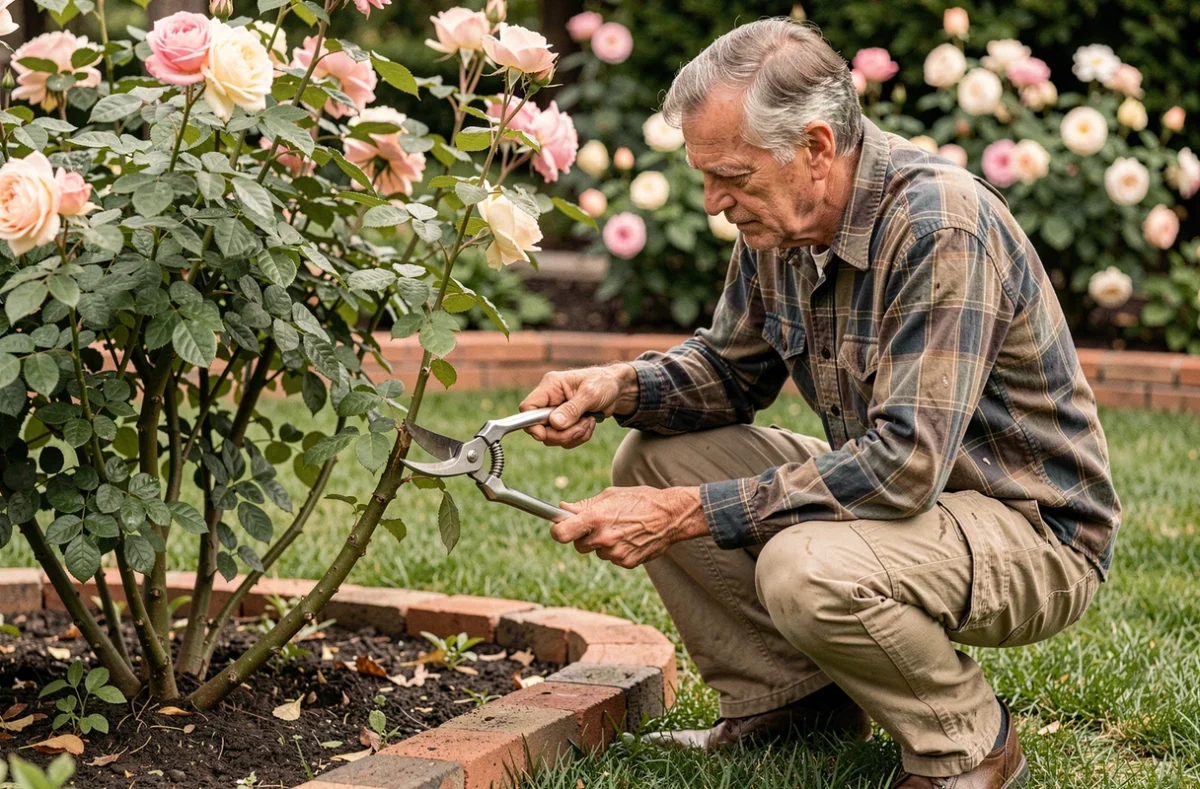
Cutting a sucker with pruning shears at ground level is the most common method, but also the least effective. The cut leaves dormant buds at the base of the shoot, on the wood of the rootstock, intact. These buds sprout again in a few weeks, often multiplying the problem.
We recommend uprooting at the point of origin. The procedure is straightforward:
- Clear the soil around the base of the rose bush to expose the starting point of the sucker on the rootstock or root.
- Firmly grasp the shoot at the base and pull it out in a sharp downward motion, taking the heel (the portion of tissue connecting the sucker to the supporting wood) with it.
- Fill the hole with the displaced soil and lightly compact it to avoid exposing the graft point to air.
- Check the area every two to three weeks during the growing season for any potential regrowth.
Uprooting destroys the bulge of dormant buds at the base. Healing occurs naturally. Wound paint does not prevent regrowth and provides no demonstrated benefit in this specific context. It is better to invest this time in regular monitoring.
Suckers from roots: the trap of distant shoots
A shoot can emerge some distance from the base, sometimes twenty or thirty centimeters away, from a lateral root of the rootstock. This case is common with Rosa canina, whose sprawling root system colonizes the soil around the rose bush.
Cutting the stem at ground level leaves the root intact and capable of regrowing. We clear the root with a spade or hoe up to the insertion point, then cut the root itself on either side of the shoot to remove the entire portion bearing adventitious buds.
This type of sucker is the most difficult to eradicate because it often goes unnoticed. The shoot emerges in the middle of a bed, sometimes far from the rose bush, and can be mistaken for a spontaneous seedling. The difference is clear to the touch: the rootstock shoot is woody from the base, while a seedling from the year remains herbaceous.
Prevention of suckers: graft depth and soil maintenance
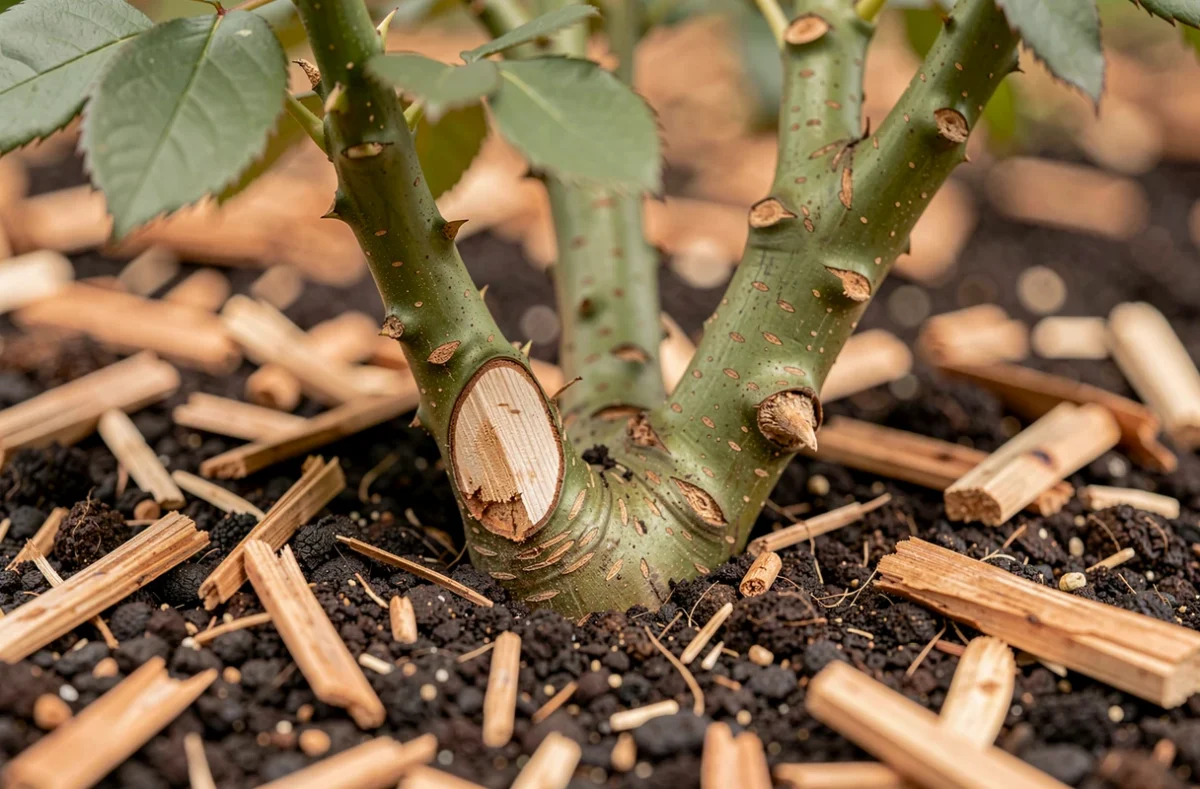
The frequency of sucker appearance largely depends on the depth at which the grafting point was planted. A graft point buried too deeply stimulates the rootstock by placing it in conditions favorable for sucker production. Conversely, a graft point that is too exposed suffers from frost and mechanical shocks.
The recommended position places the graft bulge just at soil level, or slightly above in mild climates. In cold regions, a slight winter hilling protects the graft point without permanently burying it.
Root injuries caused by deep digging or aggressive hoeing at the base of the rose bush can also trigger sucker production. We limit soil work to the surface within a thirty-centimeter radius around the collar and favor organic mulching that reduces the need for mechanical weeding.
Monitoring frequency by season
Suckers primarily appear between spring bud break and mid-summer, when sap flow is at its peak. Inspecting every two weeks from March to July is sufficient to spot them before they divert too many resources. At the end of the season, vigilance can be relaxed: autumn shoots remain rare and weak.
A rose bush that recurrently produces suckers despite careful uprooting sometimes indicates a weakening of the grafted cultivar (fungal disease, deficiency, inappropriate pruning). The more resilient rootstock then takes over. Addressing the cause rather than the symptom remains the only sustainable response.