
The confusion between “je pourrai” and “je pourrais” is among the most persistent errors in written French. Even after high school and higher education, this hesitation over a single letter – a final “s” – persists more than most other conjugation mistakes. The stakes go beyond school grammar: several recent professional writing guides published by APEC and Pôle emploi highlight this confusion as a “marker of negligence” in emails and cover letters.
Simple future and present conditional of the verb pouvoir: comparative table
Before analyzing the contexts of use, a summary table allows us to visualize the problematic endings. The logic is the same for all verbs, but “pouvoir” concentrates the errors because its pronunciation masks the difference.
| Pronoun | Simple future (indicative) | Present conditional |
|---|---|---|
| je | pourrai | pourrais |
| tu | pourras | pourrais |
| il / elle | pourra | pourrait |
| nous | pourrons | pourrions |
| vous | pourrez | pourriez |
| ils / elles | pourront | pourraient |
The trap focuses on the first person singular. The other persons have distinct endings when spoken (-ra vs -rait, -rons vs -rions). With “je”, the pronunciation of “pourrai” and “pourrais” is almost identical, which explains why the error survives years of practice.
To understand the rules for saying je pourrai or je pourrais, one must reason based on the meaning of the sentence, not the sound.
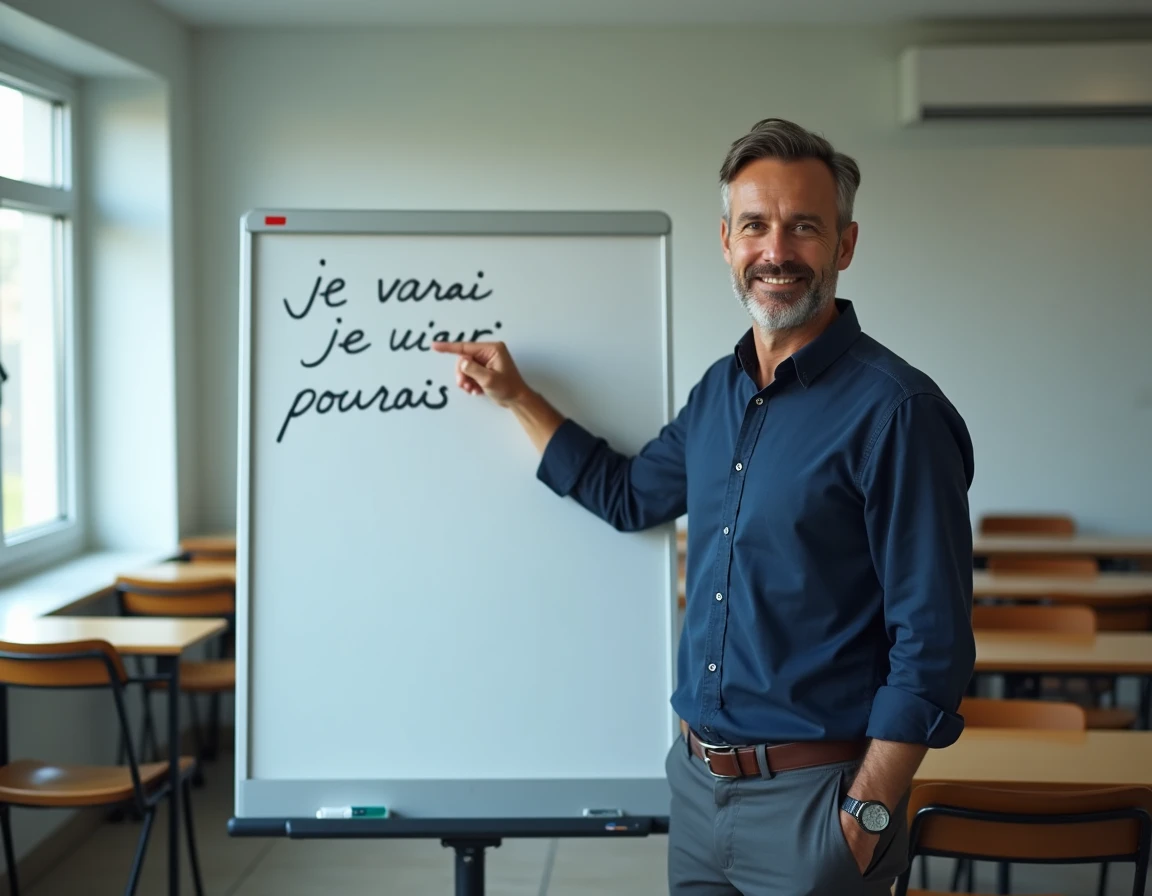
Why replacing with another verb clarifies the question
The most reliable method does not rely on memorizing the endings. It consists of replacing “je” with “il” or “nous” in the tested sentence, which makes the difference audible.
- “Tomorrow, I will be able to come” becomes “Tomorrow, he will be able to come” – the future is clearly heard, so we write “pourrai” without an s.
- “If I had the time, I could come” becomes “If I had the time, he could come” – the conditional is heard, so we write “pourrais” with an s.
- “I could help you if you asked me” becomes “We could help you if you asked us” – the ending in -ions confirms the conditional.
This test works because the confusion only exists in the first person singular. As soon as we switch to another person, the ear does the work that the eye cannot do alone.
Application beyond the verb pouvoir
Recent school grammars (Magnard and Nathan collections, 2024 programs) recommend working on this reflex in parallel with several irregular verbs: “j’irai / j’irais”, “je ferai / je ferais”, “je verrai / je verrais”. The logic is strictly identical. The future takes -rai, the conditional takes -rais. Practicing the block rather than the isolated verb reduces errors more sustainably.
Context of the sentence: the true criterion for choosing between future and conditional
The substitution test provides the mechanical answer. Understanding the meaning of each tense avoids the need to test every sentence.
“I will be able to” expresses a future capacity considered certain. The sentence is part of a plan, a forecast, a commitment. The speaker asserts that the action will take place.
“I could” expresses a hypothetical capacity, subject to a condition (stated or implied). The speaker envisions a scenario, formulates a politeness, or expresses doubt.
Cases that trap writers
The difficulty arises when the condition is not explicit. “I could come tomorrow” seems to speak of the future, but the sentence implies “if nothing prevents me.” The conditional here translates an uncertainty or a polite suggestion.
On the other hand, “I will be able to come tomorrow, it’s confirmed” leaves no room for doubt. The simple future is required because the action is presented as certain.
In a professional email, this choice alters the message received by the recipient. “I will be able to send you the file on Monday” is a commitment. “I could send you the file on Monday” is a suggestion, even a way to leave an escape route.

Automatic correctors and limits of contextual detection
One might think that online correction tools solve the problem. Both forms are grammatically correct, which complicates the task for correctors. Software detects a typo or an impossible agreement, but differentiating a desired future from a desired conditional often exceeds its capabilities.
If the sentence contains a clear time marker (“tomorrow”, “next week”) or a conditional structure (“if + imperfect”), the corrector can guide its suggestion. Without these clues, it lets the error pass or offers both options without making a choice.
This technical limit reinforces the need to master the rule oneself. In a context of application or professional writing, proofreading by applying the substitution test with “il” remains more reliable than a corrector alone.
Future or conditional in a cover letter: the impact on credibility
The writing guides from APEC and Pôle emploi published between 2023 and 2024 explicitly mention the future/conditional confusion as a negative signal for recruiters. The choice between “I will be able to bring my skills to your team” and “I could bring my skills to your team” is not a detail.
The simple future asserts a conviction. The present conditional nuances, hesitates. In a cover letter, the future conveys the candidate’s confidence. The conditional can give the impression of a lack of assurance, unless it accompanies a polite formula (“I could, if you wish, present my background to you”).
The unintentional confusion conveys neither confidence nor politeness. It signals a fragile mastery of writing, which recruiters quickly identify in a short document like a letter or application email.
The reflex to anchor consists of one operation: replacing “je” with “il” or “nous”, listening to the ending, and choosing accordingly. This verification takes a few seconds and eliminates an error that neither habit nor automatic correctors reliably remove.